How Long Should a Bird Light Be On Each Day?

Creating a healthy indoor environment for your bird starts with one simple but often overlooked question:
How long should your bird’s light stay on each day?
The answer isn’t just about brightness — it’s about rhythm, routine, and replicating the natural day-night cycle birds rely on for health and happiness.
Why Lighting Duration Matters
In the wild, birds wake with the sun and wind down at dusk. Their internal clocks — called circadian rhythms — are set by the rising and setting of daylight.
When birds are kept indoors, they lose those consistent natural cues. Artificial lighting becomes their new sun, and your job is to make it act like one.
Getting this right supports:
Predictable sleep and wake cycles
Reduced stress and anxiety
Balanced hormone regulation
Healthy activity and feeding patterns
The Ideal Daily Light Schedule for Birds
Most birds need about 10–12 hours of full-spectrum daylight followed by 10–12 hours of darkness.
This mimics a tropical day — where many pet birds originate — and gives them the clarity and consistency their bodies expect.
|
Time of Day |
What Your Bird Needs |
|
Morning (7–9 AM) |
Gradual sunrise (dimmer light) |
|
Day (9 AM–7 PM) |
Full daylight (10–12 hours) |
|
Evening (7–9 PM) |
Gradual sunset (dimmer light) |
|
Night (9 PM–7 AM) |
Darkness or soft ambient light |
What Happens If Light Cycles Are Too Long or Inconsistent?
Too much light — especially at night — can confuse your bird’s internal clock and lead to:
Restlessness
Hormonal imbalance
Poor sleep
Night frights
Likewise, too little light can reduce activity, lower mood, and even affect feather health and appetite.
You’re not just flipping a switch — you’re setting a daily structure.
How to Keep It Consistent
Timers are your best friend.
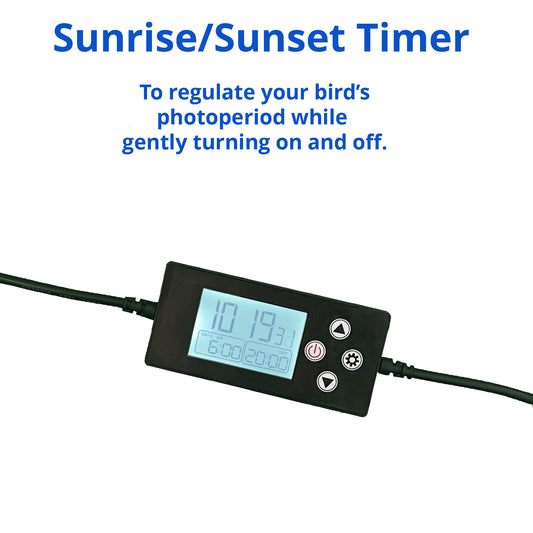
Instead of manually turning the light on and off every day, use an automatic timer that ensures a consistent schedule — even when you’re not home.
Fade-in/fade-out options are even better, allowing for gradual transitions that feel more like sunrise and sunset (and less like a sudden spotlight).
Why HappyBird Lights Are Designed for This
At HappyBird, we know that duration matters just as much as spectrum and brightness. That’s why:
All lights are compatible with timer accessories
Light quality remains stable and flicker-free throughout the day
No disruptive UVB or blue-heavy spikes, even with long durations
You can pair our lights with fade-in timers for a gentle start to the day
Your bird wakes up to a safe, natural rhythm — not a blinding shock.
Final Thoughts
There’s no mystery here: birds thrive on structure.
Lighting that mimics the natural sun — and turns off when the “day” is done — supports calm behavior, better rest, and a happier bird overall.
🕰️ Aim for 10–12 hours of full-spectrum light followed by 10–12 hours of darkness, and keep it consistent.
Because when it comes to indoor bird care, timing is everything.